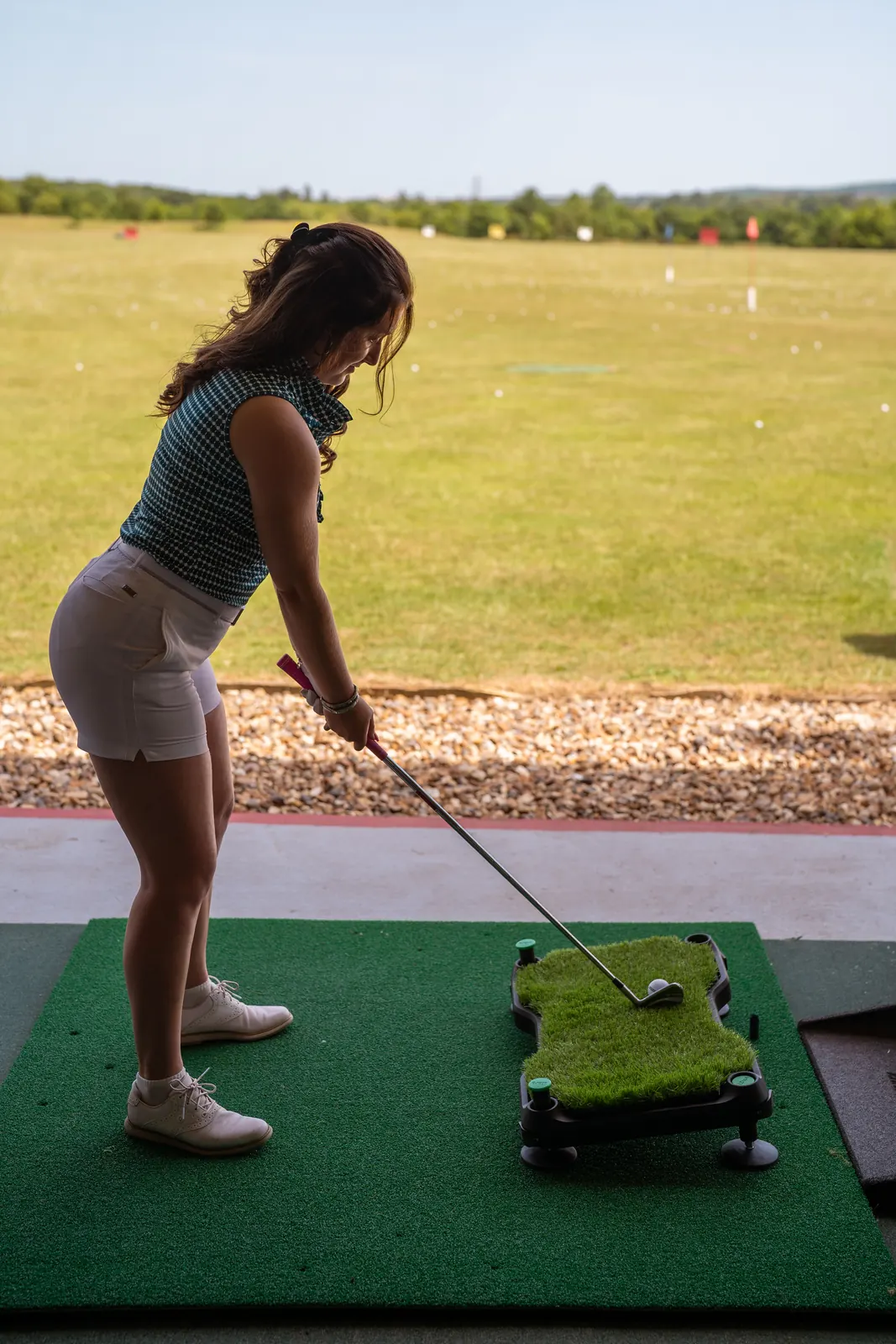
The golf practice mistakes that waste the most time are hitting without a target, hitting one club over and over, rushing through a basket, only ever practising from flat lies, and spending all the time on the long game when the short game costs more shots. All of them feel productive. Most of them make you better at the range and not much better at golf.
Here's each one, roughly in order of how common it is, with what to do instead.
1. No target
You walk into the bay, tip out the basket and start hitting. Somewhere out there, sort of. Watch any range on a weekday evening and half the people are doing this.
Without a target you can't tell if a shot was good. A ball that starts at the 150 flag and drifts 20 yards right feels fine if you weren't aiming at anything. On the course it's in the trees.
Pick a specific target for every ball. A flag, a sign, a patch of discoloured grass. Line up to it from behind the ball like you would on the course.

2. Hitting the same club for the whole basket
Usually a 7-iron, sometimes a driver. Fifty balls with one club and one target. By the end you're hitting it well, you leave happy, and on Saturday you never hit two 7-irons in a row.
This is block practice, and it has its place when you're grooving a new move. As a whole session it doesn't prepare you for the course very well. Change club or target every few balls at least, and for much of the session change every ball. There's a full explanation in block vs random practice.
3. Rushing
Ball, hit, next ball, hit. A basket of 80 in 25 minutes.
When you rush, you don't learn much from each shot, and you stop doing anything like your on-course routine. You also start making mini swing changes after every ball, which usually leaves you more confused than when you started.
Slow down. Move the basket behind you so you have to step away to get each ball. Take a practice swing. Use your routine. Fewer balls, better attention.
4. Only practising from flat lies
This one is easy to miss, because ranges make it the default. Every bay is level. Every mat is the same. You can practise for years and never hit a shot from a slope outside a round.
On the course, flat lies away from the tee are rarer than people think. Fairways roll. Balls run into hollows and onto banks. Then the setup that works perfectly on the mat gives you a fat, thin or pulled shot, and you blame your swing when really it was the lie.
You don't need to practise slopes every session. You do need to practise them sometimes. A grass range with a bank at the edge, a short game area, a slope in the garden, or a platform in a sim bay all work. For why flat-mat practice holds people back, see why practising on a flat range mat holds your game back.
5. Skipping the short game
The range is more fun. Hitting drivers feels like golf. But for most club golfers, more shots go around the green than off the tee.
If you practise for an hour, aim for at least half of it on chipping, pitching, bunker play and putting. If you only get one session a week, think about making it a short game session.

6. Practising the shots you're already good at
Everyone has a favourite club. It's nice to hit, and it makes the session feel good. But the shots that cost you are the ones you don't like. The bunker shot. The 60-yard pitch. The downhill lie with a long iron.
Look at your last few rounds and find the shot that keeps costing you. Spend a chunk of each session on it, even though it's less fun.
7. No plan
Arriving at the range without a plan means you'll do whatever feels right in the moment, which is usually mistakes 1 to 6.
A plan doesn't have to be detailed. A line in your phone saying "20 mins wedges at three distances, 10 mins driver at a fairway, 10 mins chipping" is enough. A practice journal helps you choose what to work on next time.
8. Every ball is a swing thought
If every ball is about mechanics, you'll get to the course with a head full of positions. That's hard to play with.
Split sessions into "working on it" and "playing". Technical reps with a feel or a drill, then a block where you forget the mechanics, use your routine and just hit the shot. The practise like you play post covers the playing part.
9. Ignoring how it felt
The ball flight tells you a lot. The strike tells you more. On a mat, a heavy strike that bounces off the surface can still fly OK, when on grass it would have dug in and come up well short. Pay attention to the feel and sound of contact, and be honest about the ones you got away with.
Which matters most?
If you only change one thing, add a target to every ball. If you change two, add variety. After that, work on the lie and the short game. You don't need more practice time to fix any of these.
The flat-lie problem is the hardest to fix at a range or at home, because you need somewhere to stand on a slope. Libro is a portable platform that sets uphill, downhill and sidehill lies in seconds and works with any launch monitor or simulator, or on its own. You can reserve one for £10, fully refundable, before the Kickstarter in early 2027.