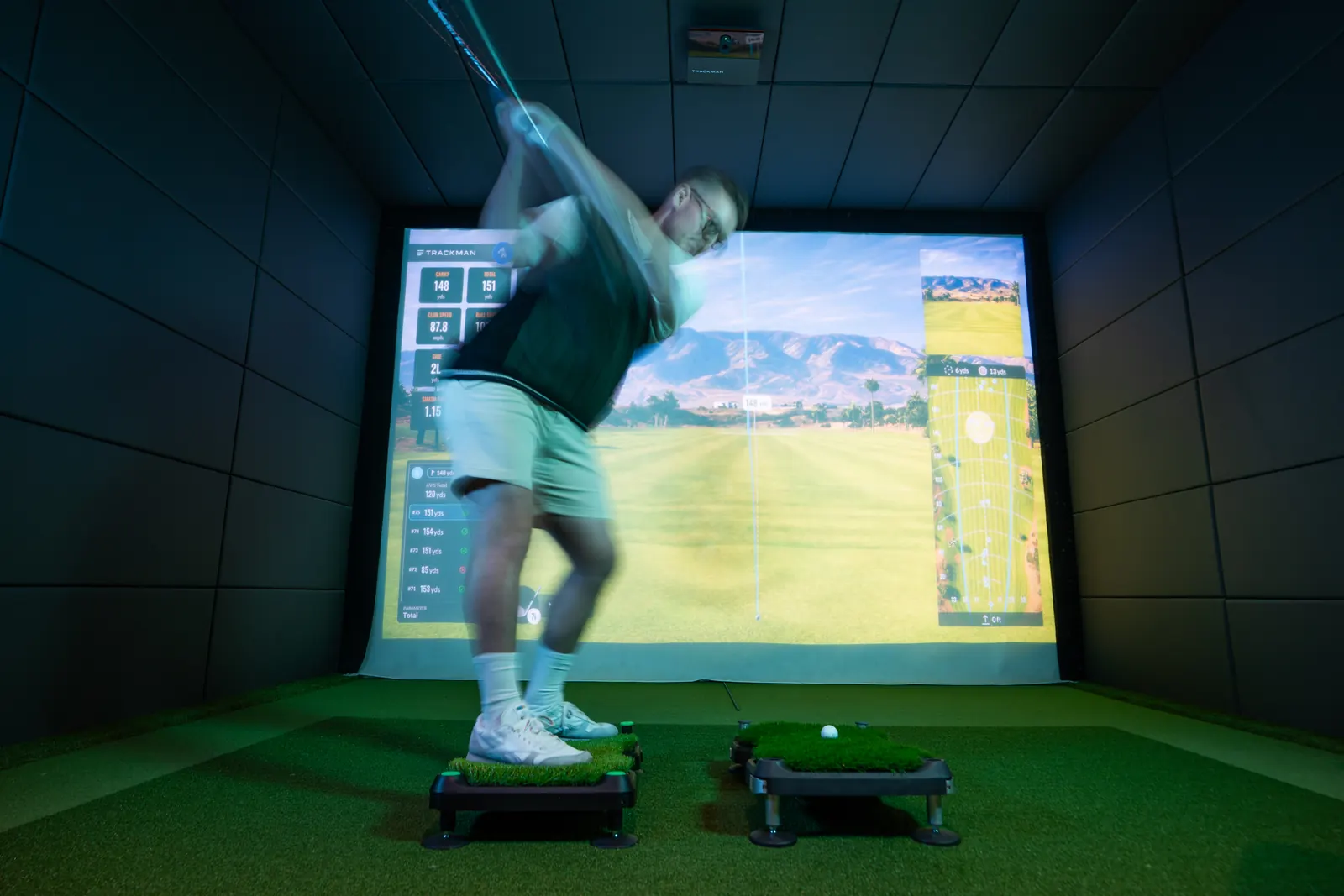
To get the most from a hired golf simulator bay, decide before you arrive whether the hour is for practice or for playing, bring your own clubs, warm up properly, and spend at least part of the time in range mode with a plan. If you're sharing with mates, agree the format first so nobody spends 40 minutes waiting. Below is how to make an hour or two in a sim bay count, from booking to the drive home.
Before you book
Bays get busy on winter evenings and weekends, so off-peak slots are often easier to get and quieter to practise in. Check a few things with the venue before you turn up:
- Whether you can bring your own clubs (most people prefer to).
- Whether you need to use their balls, or can bring your own.
- What footwear they allow on the mat. Some ask for clean trainers.
- Which software and modes the bay offers. Range mode, courses, skills games.
- Whether you can save or email your session data.
Every venue sets its own rules, so ask rather than assume.

Practice hour or playing hour?
Try not to mix the two without thinking. An hour goes fast in a bay. If you plan to "do a bit of practice then play nine", the practice often shrinks to five minutes and you end up playing a round from flat lies with cold hands.
If the aim is to improve, spend most of it in range mode with a structure. Our golf simulator practice plan gives you a 60-minute layout you can take straight into a bay. If it's a social night, play the course and enjoy it. Both are fine. Just pick one.
Warm up before your slot starts
Paying by the hour makes people skip the warm-up. A few stretches and some slow swings with a wedge in the car park or waiting area save you the first ten minutes of rubbish shots.
Bring the right kit
- Your own clubs, cleaned. Clean grooves give you more honest spin numbers.
- A glove, plus a spare if it's a long session.
- A towel.
- Water. Bays can be warm.
- A notebook or your phone notes. Write down carry yardages while you have the numbers in front of you.
- Strike spray or foot powder if the venue doesn't mind. It shows where you're hitting the face.
Use the numbers properly
A good bay gives you launch monitor data on every shot. That's worth more than the pretty course graphics if you want to get better. Focus on a few numbers rather than all of them: carry, how far offline, start direction and, if it's shown, face to path. If those mean nothing yet, our guide to launch monitor numbers for beginners explains them in plain English.
The one-off value of a bay is checking your yardages. Ten balls with each club, note the typical carry, and you've got a better yardage chart than most people at your club.
Sharing with mates
Sim bays are great with two to four people, as long as you agree how it'll work.
- For practice: take turns in blocks of five balls. You rest your swing while they hit, and you can watch each other's numbers.
- For playing: pick a course, set gimmes and mulligans before the first tee, and keep it moving.
- For games: closest to the pin from set yardages, longest drive in the fairway, or a wedge ladder (30, 50, 70, 90 yards). There are more ideas in golf practice games to play with your mates.
Stand well back from the hitting area when someone's swinging. Mishits off a mat can go in strange directions, and bays are tighter than a driving range.
Make it count on the course
A sim bay gives you perfect, flat lies and still air, unless you switch the wind on. Turn the gimmes off if you want an honest score. Use real courses rather than the easiest one.
The bigger gap is the lie. Real fairways rarely give you flat ground, and the bay mat always does. For a right-hander, ball above the feet tends to go left, ball below tends to go right, and uphill and downhill lies change height and distance. A bay is great for your strike and your numbers. It won't teach you those lies. There's more on that in why your simulator scores don't match the course.
Quick answers
Is an hour in a sim bay enough? For focused practice, yes. For a round of 18 with friends, you'll usually want longer.
Do I need to be good to use a sim bay? No. Beginners get a lot from seeing their numbers.
Can I use my own balls? It depends on the venue. Ask when you book.
Libro was designed for exactly this kind of flat-floor setup. It's a portable platform, 4.97 kg, that tilts to recreate uphill, downhill and sidehill lies and works with any simulator or launch monitor. No batteries, no subscription, and the cam lock sets a lie in seconds, so it suits short sessions where every minute counts. Check with the venue before you bring kit of your own into a bay. Reserve one for £10 ahead of Kickstarter in early 2027.