
On most slopes, go a little wider than your normal stance, enough to feel stable but not so wide that you can't turn. The lie where wider helps most is the ball below your feet, along with steep downhill lies. With the ball above your feet, your normal width is usually fine because you're standing taller. And the shorter the club, the less you need to widen, since a wedge swing doesn't need the same base as a 5-iron.
Everything here is for a right-hander, but stance width doesn't care which side you swing from.
Why width matters more on a slope
Your stance is your base. On flat ground your normal width gives you enough stability to turn and shift without wobbling. On a slope, gravity is pulling you one way the whole time. A slightly wider base makes it easier to stay balanced through the swing and hold your finish.
The catch is that width costs you turn. The wider your feet, the harder it is for your hips to rotate, and the more your swing becomes all arms. Go too wide and you'll be stable at address and stuck at the top.
So the aim is just wide enough. A lot of golfers who struggle on slopes are either standing exactly as they would on the flat or have gone so wide they can barely move.
Lie by lie
Ball below your feet
This is the one where wider genuinely helps. The slope tips you towards the ball, and to reach it you're bending more and flexing your knees more. A wider stance lowers your centre of gravity and gives you a stronger base to stay down through the shot. Go noticeably wider than normal on a steep slope. The full set-up is in ball below your feet.
Ball above your feet
The ball is closer to you, so you stand taller. Your normal width is usually right, maybe a fraction wider if the slope is steep. Going very wide while standing tall feels awkward and limits your turn, and the swing is already flatter than usual.
Uphill
A touch wider than normal helps you resist falling back down the slope. You still need to move through to your lead side, so don't go so wide that getting there becomes a struggle.
Downhill
Steep downhill lies are where a lot of golfers lose their balance, often falling forward after impact. A slightly wider stance helps you stay steady while the club chases down the slope. Some golfers take a small step down the hill after the shot, which is fine as long as it happens after the ball has gone.
Club length matters too
On flat ground your stance narrows as the club gets shorter. That doesn't change on a slope. You might add a little width to every club, but a wedge stance on a slope is still narrower than a 5-iron stance on a slope. For short pitches and chips from awkward lies, a narrow stance with your weight set to suit the slope is usually more useful than a wide one.

Width and weight work together
Width alone won't keep you balanced if your weight is in the wrong place. On an uphill lie more weight sits on your trail foot, on a downhill lie more on your lead foot. Ball below your feet, sit back towards your heels. Ball above, lean towards the balls of your feet. The details are in weight shift on a slope.
Wet or soft ground
When the slope is wet, footing becomes a bigger issue than width. Spread your feet a bit, make sure your spikes are gripping, and make your swing smaller. If you can't get a stance you trust, consider a more conservative shot. Wet ground and sloping lies has more on this.
A simple test
Take your stance, then make a practice swing at about 80 percent and hold your finish for a count of three. If you wobble, go a little wider. If you can't turn your hips properly or your finish feels cramped, go a little narrower. You'll usually find the right width within a few practice swings. If balance is a regular problem, balance on uneven lies explains why a smoother swing helps more than any change in width.
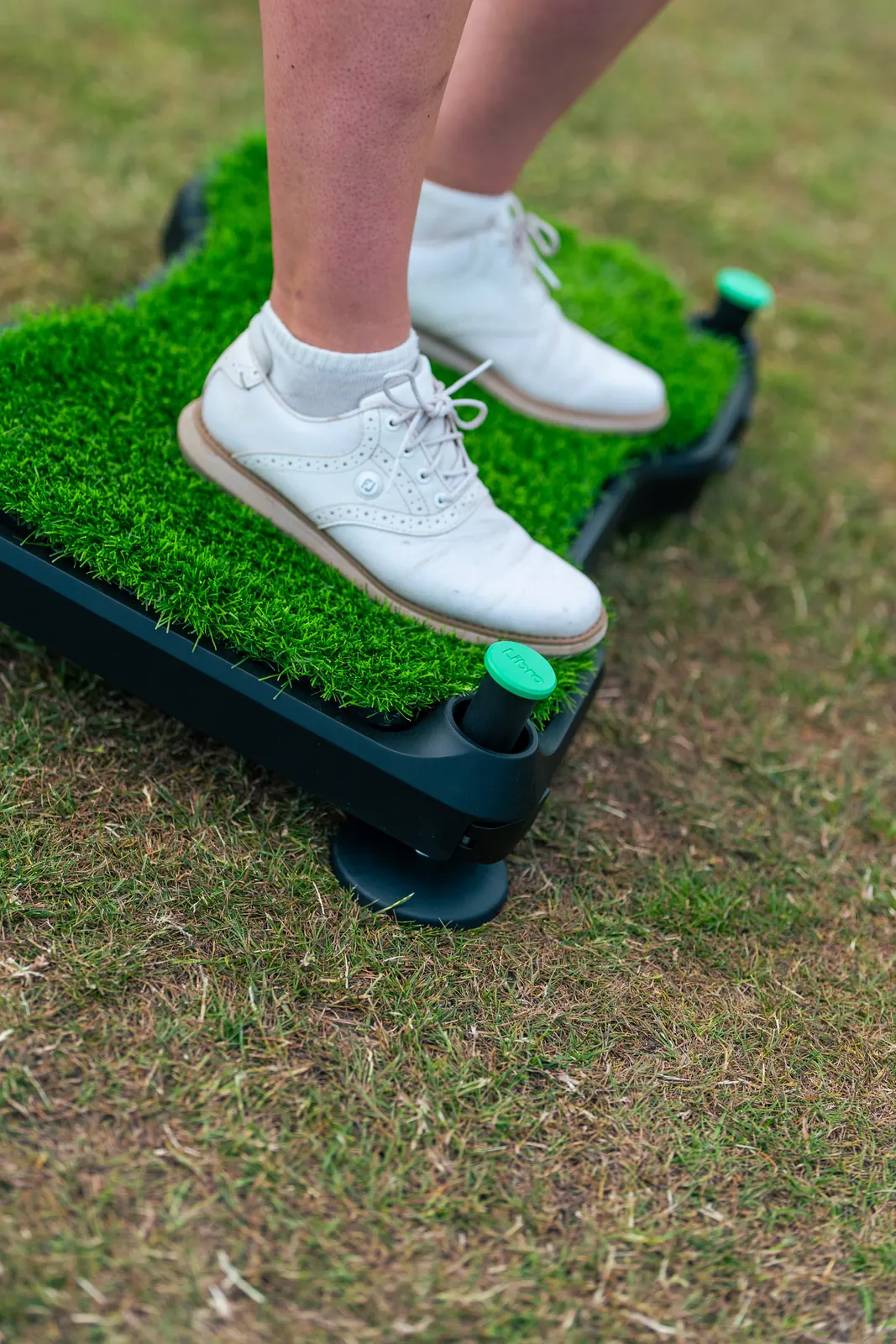
Finding your width on each slope takes reps, and those are hard to get on a flat range. Libro is a portable platform that tilts to recreate uphill, downhill and sidehill lies, up to 7 degrees along its length and 13 degrees across, so you can test stance widths on the same lie until it feels right. It's coming to Kickstarter in early 2027, and you can reserve one for £10, fully refundable.