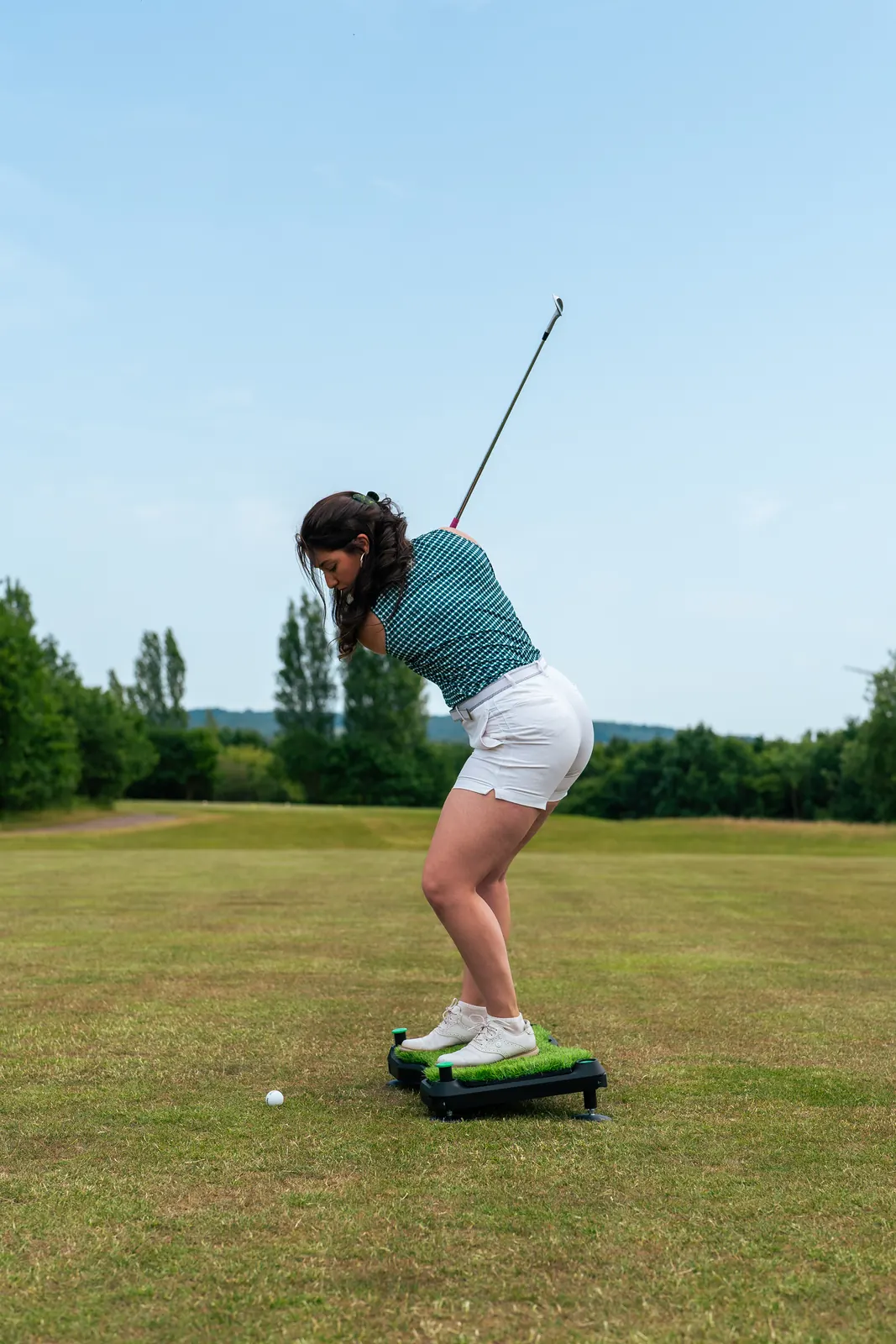
Most bad shots from sloping lies come from losing your balance. The slope bending the ball matters less than people think. Swing at roughly 80 percent of your normal effort, take an extra club to cover the lost distance, and set your weight at address so the slope can't pull you over. If you can hold your finish for a few seconds, you stayed balanced. If you can't, that's usually what went wrong.
"80 percent" is a feel, of course. Nobody is measuring it. It means a swing that feels controlled and a bit lazy, the kind you'd make if you were nervous about hitting a ball too far.
Why balance is the real problem
Picture a downhill lie. Gravity pulls you towards the target. If you make your normal full swing, you'll drift forward on the way down, your low point moves, and you top the ball or hit it thin. On an upslope you fall back, and the low point slides behind the ball. Fat.
Ball above your feet rocks you back on to your heels. Ball below your feet pulls you on to your toes and you tend to stand up out of the shot to stop yourself toppling.
In every case the slope is trying to move your body somewhere during the swing. The faster and longer you swing, the more chance it has. A shorter, smoother action gives it less time and less force to work with. That's the case for 80 percent, and it's why almost every coach tells you to swing easier on a slope.

Set your weight before you swing
Good balance starts at address. The aim is to lean into the slope just enough that you feel stable before you take the club back.
| Lie (right-hander) | Where to feel your weight | What it stops |
|---|---|---|
| Uphill | More on the lower, back foot, with shoulders along the slope | Falling back too far, or lunging forward |
| Downhill | More on the lower, front foot, shoulders along the slope | Hanging back and topping it |
| Ball above feet | Slightly towards the balls of your feet | Rocking back on your heels |
| Ball below feet | Slightly towards your heels, knees well flexed | Toppling forward on to your toes |
The detail is in the weight shift on a slope post. The short version is that you work with the slope at address and then try to keep that weight roughly where it is during the swing, instead of making your usual big shift.
Widen your stance, a bit
A slightly wider stance gives you a bigger base. On a steep sidehill lie especially, a few extra inches between your feet makes a real difference to how still you can stay.
There's a trade-off. A very wide stance restricts your hip turn, which shortens your swing. On a slope that's often fine because you want a shorter swing anyway. But don't go so wide that you can't turn at all. How wide is right depends on the slope and on you, and the post on stance width on slopes goes through it.
Grip down
Choking down an inch or so on the grip shortens the club. A shorter club is easier to control, makes contact more reliable and naturally takes a bit of speed off. On ball-above-feet lies you need to grip down anyway because the ball is closer to you.
Combine gripping down with a smoother swing and you might lose a club or more of distance. That's why the advice is to take one more club and swing easier. A 6-iron at 80 percent from an uphill lie is usually a better bet than a full 7-iron.

Rehearse it first
A practice swing on the slope tells you two things. Where the club brushes the ground, which shows you where to put the ball. And whether you can swing at that pace and stay on your feet.
Make the practice swing at the pace you plan to hit it, next to the ball on the same slope. If you wobble on the practice swing, you'll wobble on the real one. Shorten it until you don't. Using your practice swing to read the lie is worth reading too.
Hold your finish
This is the best check there is, and it costs nothing. After the shot, hold your finish and count to three before you move.
If you can, you swung within yourself and stayed in balance. If you had to step forward, back or sideways to stop yourself falling, you swung too hard for the slope. That information is useful whatever the ball did. A good result from an unbalanced swing is luck. A bad result from a balanced one usually means the set-up or the aim was off, which is easier to fix.
On a downhill lie in particular, many players find it helps to let the trail foot walk through after impact, towards the target. If that happens naturally, fine. Just make sure it's after the ball has gone and not a stagger mid-swing.
A simple tempo cue
If "80 percent" doesn't mean much to you, try a count. Say "one" on the way back and "two" as you swing through, at a slow, even rhythm. It's hard to lurch at the ball when you're counting. Some players prefer to think about making a three-quarter backswing, with their lead arm stopping around nine o'clock. Pick whichever cue keeps you steady.
Balance is something you learn through your feet. That's hard to do on a flat mat, because a flat mat never tries to tip you over. Libro gives you a slope that does. It sets uphill, downhill and sidehill lies in seconds with a cam lock, so you can hit 80 percent shots off a real tilt and practise holding that finish. Feel what's real.