
A hanging lie in golf is a downhill lie. The ball sits on ground that slopes down towards the target, so your front foot is lower than your back foot. It's an older term, heard more in British golf, and you'll often hear it at the club before you hear it on TV. To play one, tilt your shoulders with the slope, play the ball further back, take less club, swing down the hill and expect the ball to fly lower and run.
Where the name comes from
The idea is that the ball is "hanging" on the slope, perched on ground that falls away in front of it. You'll most often find a hanging lie on the far side of a ridge in the fairway, on the back of a mound, or on the downslope of a bank near the green.
Usage is a bit loose. Most golfers mean a straightforward downhill lie. Some use it more narrowly for a ball sitting on a steep downslope, the kind where it looks like it might roll on if you breathe on it. A few people use it for any ball perched on a bank, including ones below your feet. If someone in your four-ball says "you've got a hanging lie there", they almost certainly mean the ball is on a downslope towards the green.
Why it's awkward
Two things make a hanging lie hard.
First, the ground behind the ball is higher than the ground under it. If you set up as normal and swing as normal, the club catches the slope before it reaches the ball. That gives you a fat shot or, more often, a bounce into a thin or topped one.
Second, the slope tilts you towards the target. It's easy to either fight it by leaning back, which makes the club hit the ground early, or to fall forward through the shot and lose control of the face.
The result, for a right-hander, is a ball that comes out lower than normal, tends to drift right, and runs a long way once it lands.

How to play it
The downhill lie guide has the full set-up. Here's the short version, plus a few points that matter more on a properly steep hanging lie.
Match the slope with your shoulders. Lead shoulder lower so your shoulders run roughly parallel to the ground. This lets the club travel down the slope through impact.
Weight on the front foot. Go with the slope and leave it there.
Ball back. Further back than normal for the club, often towards the middle or a touch behind. A practice swing on the slope will show you where the club brushes the ground. That's your spot.
Take less club. The slope takes loft off the face, so a 7-iron flies more like a 6. You'll often want one club less, and you'll need to plan for extra run.
Aim a little left. The ball tends to drift right from a downhill lie.
Swing down the hill. Keep the clubhead low after impact, chasing it along the slope. A lot of good players let their trail foot walk through towards the target after the ball has gone. That's fine. What you don't want is to hang back trying to help the ball into the air.
The two shots that cause trouble
The topped one. Usually caused by hanging back, so the club bottoms out behind the ball and catches it on the way up. If you're topping it from hanging lies, it's almost always weight and shoulders. The post on thin shots from downhill lies explains the low-point problem in more detail.
The one off the toe. If the hanging lie is also a sidehill lie with the ball below your feet, you have to reach for the ball and it's easy to stand up and catch it thin or out of the toe. That's one of the hardest combinations in golf. See downhill with the ball below your feet if that's the one you've got.

Club choice from a hanging lie
The flatter the club's loft, the harder this is. A driver or 3-wood from a hanging lie is a big ask for most club golfers, because there's so little loft to start with and the slope removes more. A hybrid or a mid iron is usually the smarter choice if you need distance. From a steep hanging lie near the green, a lofted wedge with a slightly open face helps you get the ball up, but expect it to come out lower than it looks.
If the lie is properly horrible, there's nothing wrong with hitting a shorter club to a flat area and playing on from there.
Quick answers
Is a hanging lie the same as a downhill lie? For most golfers, yes. Some use it only for steep ones.
Why do I top the ball from a hanging lie? Usually because your weight stays back and your shoulders stay level, so the club hits the slope behind the ball.
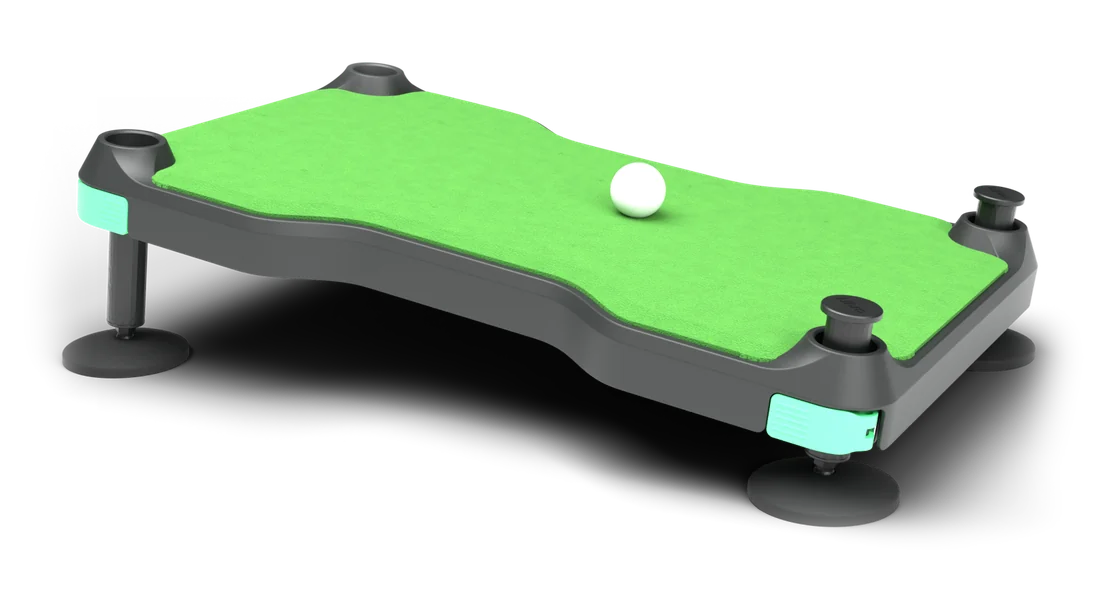
Hanging lies are hard to practise because most ranges are flat and you can't hit balls off the course's banks. Libro tilts up to 7 degrees along its length, so you can set a downhill lie at home and hit from it as often as you like. The engraved height lines let you set the same slope each time, so you can count reps and see if your strike is improving.