
For a right-hander, a downhill bunker lie means the sand falls away towards the target, so your front foot sits lower than your back foot. Tilt your shoulders to match the slope, put more weight on your front foot, play the ball in the middle of your stance or a touch back, open the face and swing down the slope after impact. The ball will come out lower than a normal splash and run much further, so plan for that before you step in.
Most club golfers rank this as the shot they least want to see. That's fair. It is hard, and the aim on a bad day is simply to be on the green or even just out.
Why it goes wrong
On a flat bunker shot the club enters the sand a little behind the ball and slides under it. On a downslope the sand behind the ball is higher than the sand under it. If you set up as normal, the club meets that higher sand too early, bounces off it, and you either thin the ball into the face of the bunker or send it screaming over the green.
The usual reaction is to try to help the ball up. You hang back on your right side and flick at it. That makes things worse, because hanging back moves the bottom of your swing even further behind the ball, into the slope.
You'll most often find this lie when the ball has run into the back of a bunker and stopped on the slope nearest you. Sometimes your back foot ends up on the grass bank outside the sand, which makes the stance feel even stranger.
Set-up, piece by piece
Shoulders. Lead shoulder lower, so your shoulders run roughly along the slope. This is the single biggest thing. It lets the club swing down and along the sand instead of crashing into it.
Weight. Most of it on your front foot, and leave it there. You should feel as if you could fall towards the green if you leaned any further.
Ball position. Middle of your stance, or slightly back of centre. Further forward and the club hits the slope before it gets near the ball.
Clubface. Open it more than you would on a flat lie. The slope takes loft off the club, so you need to add some back, and an open face also brings the bounce into play so the club skims rather than digs.
Feet. Wriggle them into the sand for grip. If the back foot is higher, flex that knee more so your hips can stay fairly level and you aren't toppling forward.
Aim. Set up a little open, as you would for a normal splash shot, with the face pointing at where you want the ball to start.
The swing
Pick the club up steeply, with an early wrist hinge. A wide, low takeaway will catch the sand or the bank behind you, so think up rather than back.
Coming down, hit the sand about where you would on a normal bunker shot, then keep the club travelling down the slope. Chase the sand towards the target with the clubhead low after impact. The finish will be short and low, and that's correct. If your follow-through climbs up high you have almost certainly tried to lift the ball.
Keep your chest moving towards the target. The moment your weight drifts back, the low point of the swing goes with it.

What the ball does
Expect a lower flight than a normal bunker shot, with less spin and a lot more run. You'll rarely stop this one quickly. That changes where you land it:
- Pick a landing spot much shorter than usual and let the ball run out.
- If the flag is cut close to your side of the green, accept that you'll probably finish past it.
- Look at the slope of the green too. A green running away from you on top of a downhill lie means the ball could roll off the far side.
When to stop thinking about the flag
Sometimes the honest answer is to get out sideways. If the lip in front of you is high and the ball sits on a steep downslope, the club simply can't produce enough height to clear it. You'll see this when you stand over it and the lip fills most of your view.
Your options then are to play out to the side where the lip is lower, or to the fattest part of the green. In a really bad spot the Rules of Golf also let you declare the ball unplayable. In a bunker, one option is to drop outside the bunker, back on the line from the flag through where the ball lay, for two penalty strokes. It's rarely the glamorous choice, but one dropped shot beats three swipes in the sand.
If you want the basics of the slope itself, the general downhill lie guide covers set-up out on the fairway. The uphill bunker shot is the mirror image and a lot friendlier.

Practising it
Most practice bunkers have a back slope. Drop five balls on it and hit them, then move them to the flat part and hit five more. Going back and forth teaches you how much the set-up changes. If your range or club allows it, the range practice ideas here help you make the most of whatever slopes you can find.
Pay attention to the finish. Hold it for a couple of seconds. If you can stay down there, balanced, the shot was probably good even if the result wasn't.
Quick answers
Should I use a lob wedge from a downhill bunker lie? It can help because the extra loft offsets what the slope removes, but only if you're comfortable with it. A sand wedge with the face opened works for most players.
Where do I aim in the sand? About the same entry point as a normal splash. The difference is that the club has to keep going down the slope afterwards.
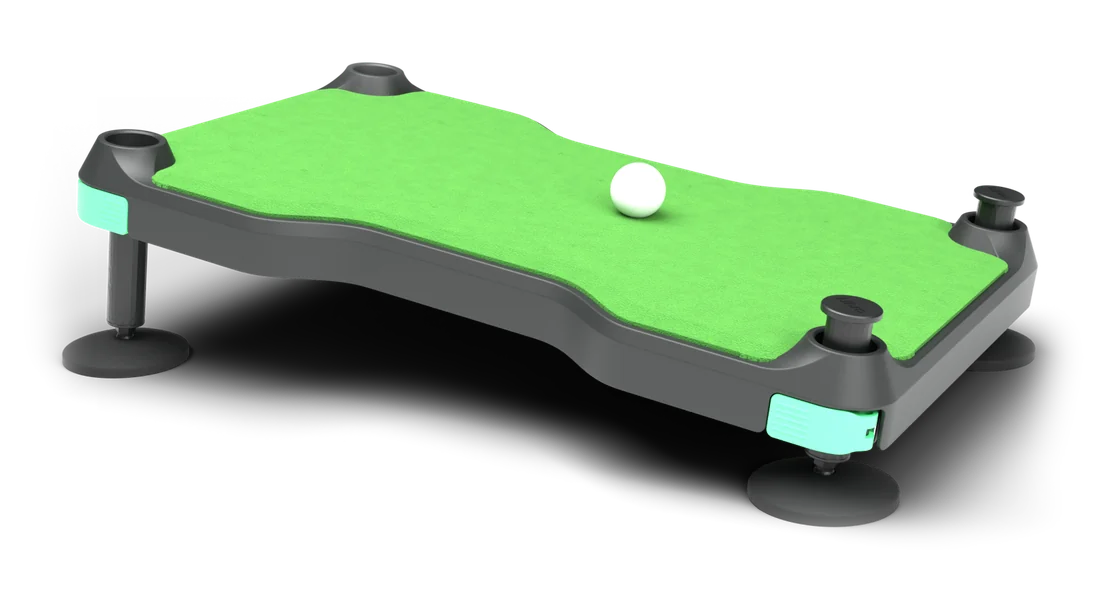
Libro won't give you a bunker, but it does give you the tilt. It sets a downhill lie of up to 7 degrees in seconds, and the engraved height lines let you set the same slope again next session. Rehearsing the shoulder angle and that low, chasing finish on a real downslope at home is the part sand practice rarely gives you enough of.