
A chip from an uphill lie comes out higher and stops faster than the same chip from flat ground, so the usual miss is short. The simplest fix is to use a less lofted club than you normally would, for example a 9-iron or pitching wedge where you would usually chip with a sand wedge, and to carry the ball further onto the green. Then decide how you will set up to the slope, because coaches teach two different ways and both work.
Uphill chips are everywhere on UK courses. Miss a raised green short and you are almost always chipping from the bank in front of it, with the ball sitting on an upslope and the flag somewhere above you.
Why the ball pops up
If your shoulders follow an upslope, the club meets the ball travelling upwards. That adds loft, so the ball launches higher and lands more steeply. It hardly rolls. A sand wedge from a decent upslope can come out so high and soft that it barely reaches the green.
On top of that, you are often chipping up to a green that sits above you, which adds a little more distance the ball has to travel. The two together explain why so many uphill chips finish on the fringe.
Taking less loft
The most reliable change is club selection. Go down in loft. If you would chip with a sand wedge from flat ground, try a pitching wedge or a 9-iron. The slope will add loft back, so the ball still gets up, but it comes out lower and gets more run once it lands.
How much less loft depends on how steep the bank is. On a gentle upslope, one club less lofted is often enough. On a steep bank in front of a raised green, a 7-iron or 8-iron chip can be the easiest shot, because it gets the ball rolling up onto the putting surface.
The same logic applies to full and partial wedge shots from upslopes, which are covered in wedge shots from sloping lies.

With the slope or into it?
This is the part where coaches disagree, so it is worth knowing both methods and choosing the one that suits the lie.
Option one: shoulders with the slope
Tilt your shoulders so they follow the ground, lead shoulder higher, as you would for a full shot from an uphill lie. Your weight will be more on your back foot. Play the ball slightly forward of centre. Then make your chipping stroke and let the club swing up the slope after impact.
This method lets the club travel freely along the ground, so it does not dig. The contact is usually clean and consistent. The downside is that the ball comes out higher, because the slope is adding loft. So you need to take less loft or make a slightly bigger stroke to get it to the hole.
Most mainstream teaching prefers this for anything more than a gentle slope.
Option two: lean into the slope
Keep more weight on your front foot, as you would for a normal chip on flat ground, and let your shoulders stay closer to level. The club comes in more steeply and hits into the face of the slope.
This keeps the ball lower and produces more of a running chip. It can be useful on a gentle upslope with tight grass, or when you want the ball to release towards a flag at the back of the green.
The risk is that the club digs into the bank and stops, and the ball comes out weakly or goes nowhere. On a steep slope this happens a lot, and digging into a hard bank can also jar your wrists. I would only use this method on mild slopes.
Picking the landing spot
Whichever method you use, the ball will roll less than you are used to. Pick a landing spot further onto the green than you would from flat ground, and commit to carrying it there. Leaving it short is the most common error by a distance.
If the green slopes back down towards you once you get onto it, take extra care. A chip that lands too short can roll back to your feet. Better to land a bit long and leave an uphill putt coming back.

The stroke
Keep it simple. A short backswing and a slightly longer follow-through, with the club moving along the ground. Hold your finish briefly. On an upslope your finish will feel a little higher than normal if you are using the shoulders-with-slope method.
Try not to help the ball up. The slope is already doing that for you. A scoopy stroke here tends to catch the ground first and produce a duff.
Use a practice stroke on the same slope to see where the club brushes the grass. That shows you where to put the ball, and it gives you a feel for how firm the stroke needs to be. The post on using your practice swing to read a sloping lie goes into this in more detail.
Quick answers
Should I use more or less loft chipping uphill? Less. The slope adds loft, so a 9-iron or pitching wedge often works better than a sand wedge.
Do you lean into the slope or with it? Coaches teach both. Shoulders with the slope is more reliable on steeper banks. Leaning into it can work on gentle slopes.
Why do my uphill chips come up short? The slope adds height and takes away roll. Use less loft and land it further on.
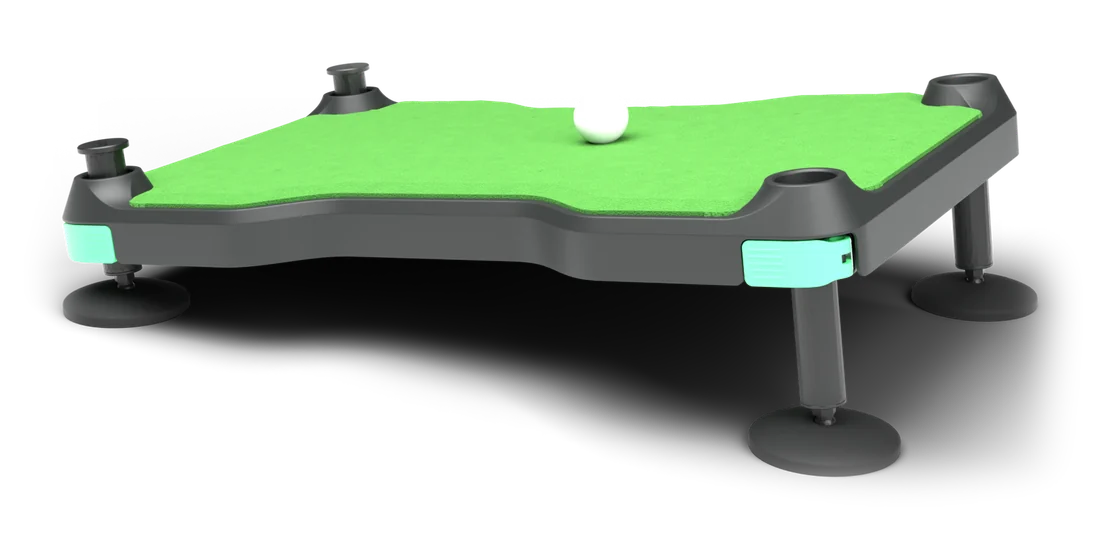
Chipping off a slope is one thing you can rehearse a lot without needing a full range. Libro is a portable platform that tilts up to 7 degrees along its length, so you can set up an upslope in the garden and hit chips with different clubs until you know how much each one rolls. It sets in seconds with a cam lock and needs no batteries. You can reserve one for £10, fully refundable, ahead of Kickstarter in early 2027.