
There's no fixed number, because it depends on how steep the slope is, which club you're holding and how you swing. As a starting point for a right-hander, on a slope you can clearly feel in your feet, aiming somewhere around 5 to 15 yards right with the ball above your feet, or left with it below, is a sensible place to begin with a mid or short iron. Then test it and adjust. The numbers below are rough guesses for you to test.
I want to be clear about that. Nobody can tell you that a 4-degree slope moves a 7-iron exactly 9 yards. Your strike, your swing speed and the grass all change it. What you can do is start with a reasonable guess and then find your own numbers.
Three things decide how much
How steep it is. Obvious, but people still underestimate it. A slope you can see but barely feel is very different from one where you have to brace to stand still.
The club. On sidehill lies, more loft means the face points further off line. A wedge from ball above your feet goes left more readily than a 5-iron does. On the other hand, the long iron flies further, so a smaller angle still adds up to a lot of yards at the end. The physics of why slopes change ball flight explains this.
You. Some players hit the ball straight off a slope because their swing doesn't react much. Some hook every ball-above-feet shot. Your normal shape matters too. If you already fade it, ball below your feet will add to that, while ball above your feet might just straighten you out.
Starting points to test
Treat this as the first guess you'd pencil on a card and expect to rub out. Everything assumes a right-hander, a decent lie and a normal, controlled swing.
| Lie | Gentle (see it, barely feel it) | Clear (feel it in your feet) | Steep (hard to stand) |
|---|---|---|---|
| Ball above feet, wedge or short iron | A few yards right | Roughly 5 to 15 yards right | 15 yards or more right, or play safe |
| Ball above feet, mid iron | A few yards right | Roughly 5 to 10 yards right | Aim well right, grip right down |
| Ball below feet, any iron | A few yards left | Roughly 5 to 15 yards left | Aim well left, think about a safer target |
| Uphill, mid iron | Little or none | A touch right, plus about one more club | Right, and more club again |
| Downhill, mid iron | Little or none | A touch left, plus about one less club | Left, less club, expect run |
Two notes on that table. First, on uphill and downhill lies the distance change usually matters more than the direction. Getting the club right will save you more shots than fiddling with your aim. Second, on steep slopes my honest advice is often not to aim off further but to change the shot. Play a shorter club to a safer spot.

How to aim off without making it worse
Aiming off only works if you swing along the new line. The trap is lining up right, then swinging at the flag anyway because your eyes can't help it. That usually produces a pull, which on a ball-above-feet lie means the ball goes miles left.
Pick a specific target on your new line. A tree, a bunker edge, a bit of discoloured grass. Set your feet, hips and shoulders to that and commit. Let the slope bring the ball back.
Also decide if you're aiming your body, your clubface or both. On sidehill lies the usual advice is aiming everything, body and face, at the new target and letting the slope do the curving. Opening or closing the face to fight the slope adds a second variable you don't need.

Finding your own numbers
This is where most golfers stop, and it's the bit that actually works.
On the course. When you hit from a slope, note what happened. Club, slope, roughly how steep, where you aimed, where it finished. A line in your phone is enough. Over a few weeks you start to see your own pattern. A practice journal makes this easier.
On practice ground. If your club has a short-game area or practice field with slopes, hit five balls from the same lie with the same club and see where they finish compared to where you aimed. Then change one thing.
With a launch monitor. If you have access to one, hit from a slope and look at start direction and curve. It takes the guessing out. The post on using a launch monitor for uneven lies covers what to look at.
The point of all three is the same. After enough reps you stop guessing. You'll know that your 8-iron from a clear ball-above-feet lie goes about this far left, because you've seen it.
Quick answers
Do I aim off on uphill and downhill lies? A little. Uphill tends left and downhill tends right for a right-hander, but the bigger change is distance.
Should I aim off more with a driver? Usually less on face angle, because a driver has very little loft. But a driver's sidespin can still curve it a long way, so don't ignore the slope.
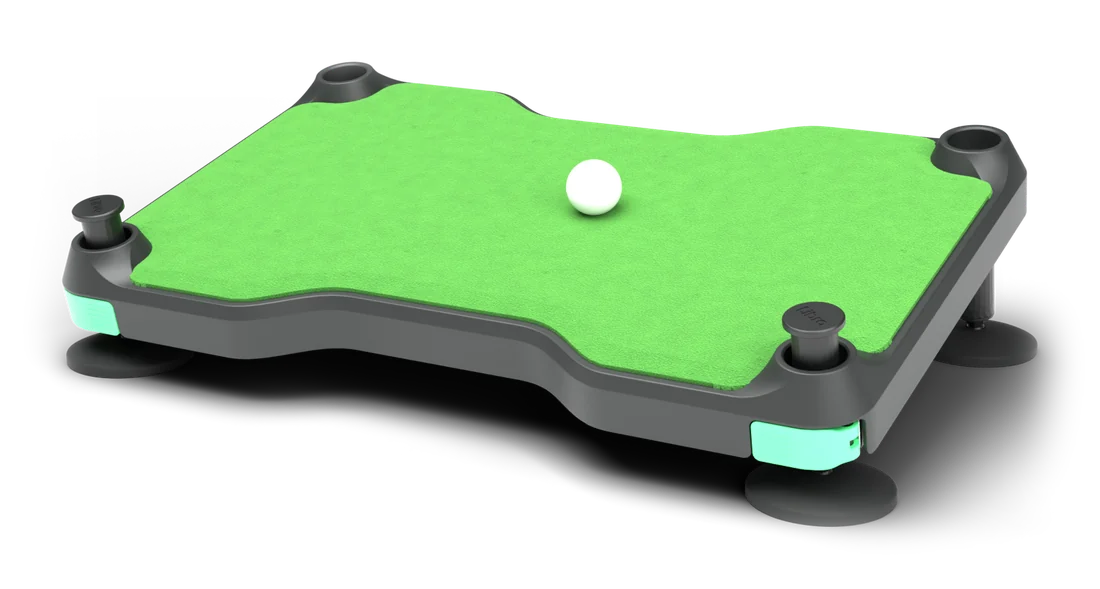
Testing your numbers is much easier when you can set the same slope twice. Libro has laser-engraved height lines, so you can set a ball-above-feet lie, hit ten shots, write down the result and set that exact lie again next week to check it. It tilts up to 13 degrees across and 7 degrees along its length, and works with any launch monitor or on its own.