
A sidehill lie with a long iron is hard because the club is long, the ball goes a long way, and solid contact is difficult even from a flat lie. For a right-hander, ball above your feet still tends to go left and ball below your feet still tends to go right, but with a 4 or 5-iron a small mistake turns into a big miss in yards. Grip down, swing at about three-quarter pace, aim for the curve and think seriously about swapping to a hybrid.
The bit most articles get slightly wrong
You'll often read that long irons "magnify" the curve from a sidehill lie. That's half right, and the half that's wrong matters.
On a sidehill lie, the slope tilts the clubface. With the ball above your feet the toe sits up and the loft on the face points left of where the leading edge is aimed. With the ball below your feet the toe drops and the loft points right. The more loft a club has, the more the face points off line. So purely on face angle, a wedge is affected more than a 4-iron. That's why a sand wedge from a steep ball-above-feet lie can shoot off left so quickly.
So why does it feel worse with a long iron? A few reasons stack up:
- Distance. A ball that starts a few degrees off line and keeps curving finishes much further from the target at 190 yards than at 100. Same error, bigger number.
- Less backspin. Long irons produce less backspin than short irons, so any sideways tilt in the spin shows up more as curve.
- Contact. Long irons are the least forgiving clubs in most bags. Add a slope that moves your balance and changes your posture, and fat, thin and toe strikes become more likely.
- Swing length. A longer club means a longer, faster swing, and more time for the slope to pull you off balance.
The short version: the slope tilts the face more with lofted clubs, but the long iron punishes you more for everything the slope does to your swing.
Ball above your feet with a long iron
The ball is closer to you, so grip down. With a long iron, you might need to choke down a couple of inches on a steep slope. Stand a bit taller and let your swing get flatter, more around your body. That flatter swing naturally sends the ball left, on top of whatever the face is doing.
Aim right of the target and expect a draw or a hook. Don't try to hold the ball up against the slope by blocking it. That tends to produce a push or a big hang-right when the hands stop, or a duck hook when they don't.
The full set-up is in the ball above your feet guide. With a long iron, the extra point is to be conservative with your target. If the hole has trouble left, you might aim well right and accept a long putt or a chip.
Ball below your feet with a long iron
This is the harder of the two. The ball is further away, so you have to bend more from the hips and flex your knees more to reach it. Keep that knee flex through the swing. The most common miss is standing up out of the shot and catching it thin, and with a long iron that often means a low slice.
Expect the ball to fade or slice right and aim left to allow for it. Widen your stance slightly for balance. The ball below your feet guide has the details.
From a severe below-feet lie, a long iron is close to the worst club you can hold. The ball is far away, the shaft is long, and the face is the least forgiving in the bag.

When to put the long iron back
Honestly, most of the time on a decent sidehill slope. A hybrid has a wider sole that glides through grass, a lower centre of gravity that makes it easier to launch, and a bigger face that forgives off-centre hits. All three help on a slope.
A lofted fairway wood, such as a 7-wood, can also work, especially from the rough. It's longer, so grip down.
Other options depend on the hole:
| Situation | Sensible choice |
|---|---|
| Gentle sidehill, decent lie, clear target | Long iron or hybrid, gripped down, three-quarter swing |
| Clear sidehill slope, trouble on the curve side | Hybrid, aim well away from trouble |
| Steep slope, ball below feet | Shorter iron to a safe spot |
| Steep slope in rough | Mid or short iron, just get it back to the fairway |
That last row will feel like giving in. It isn't, really. A 7-iron to the fairway leaves you a pitch. A 4-iron toed into a bush leaves you another sidehill lie, or worse.
Picking your number
On a sidehill slope you'll probably lose some distance from the shorter grip and softer swing. Club up one if you're going for the green, and expect the curve to cost you a few yards of carry as well. If you aren't sure how far to aim off, this post on how much to aim off on a slope gives starting points you can test.
It also helps to have practised the shot. You'll know what your own long iron does from a slope only once you've seen it a few times, and that is hard to arrange on a flat range mat.
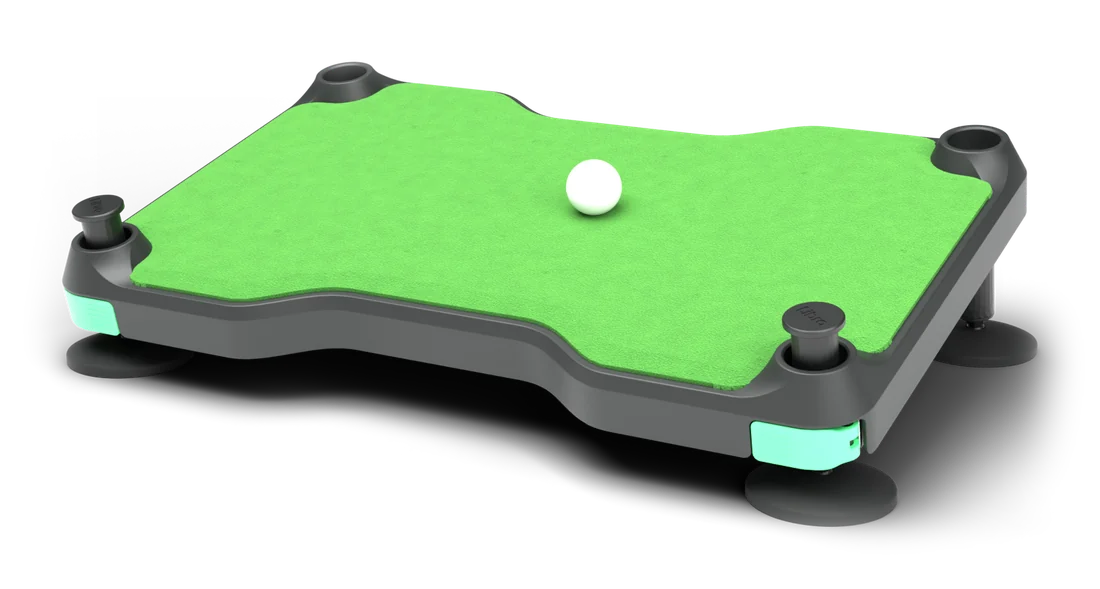
Libro tilts up to 13 degrees across its width, which is a proper sidehill slope, so you can set ball above or below your feet at home and hit your 4-iron and your hybrid off the same lie to compare. It works with any launch monitor, so you can see the curve in numbers, and the engraved height lines mean you can come back to that exact slope next week.